


There’s a certain magic to global events. The energy, the conversations, the sheer mix of people and perspectives, all in one space. However, that scale presents its own challenge: how do you make the experience feel personal? How do you make someone in the back row or on the other side of the planet feel like they’re not just watching, but part of it? That’s where social walls come in. But before we get into that, let’s get one thing straight.
Social media walls are not an afterthought, and they’re definitely not a flashy screen gimmick. What it does is something that’s far more powerful: it lets people be seen.
Whether you’re hosting a major summit in New York or a creative showcase in one of Paris’ most inspiring event spaces, you’re not just creating something for an audience. You’re working with cultures, languages, digital habits, and wildly different definitions of “engagement.” A social wall, when used well, can do something a panel discussion or keynote can’t: reflect everyone back to themselves.
Let’s start here. A social wall is essentially a live feed of content, typically user-generated, that’s pulled from social platforms, event apps, or direct uploads. But the best ones aren’t just dumping grounds for hashtags. They’re curated, real-time storyboards.
Imagine this:
Someone tweets a photo of their custom lanyard. Another posts a clip of the keynote in Spanish. A third uploads a selfie from the rooftop after-party. A few seconds later, all of that is up on the big screen. And suddenly, this isn’t just your event anymore. It’s theirs, too.
And that changes everything.

Why local still matters
One of the biggest traps global event planners fall into is trying to appeal to everyone. The result? A lot of beige. Safe content, broad themes, and a vibe that could belong to any city on earth.
But even at global events, location still matters. Whether it’s Seoul, São Paulo, or Paris, the host city adds character, and a social wall is one of the few tools that lets you tap into that personality.
You can:
- Highlight content from the host city or region: A quick filter and your wall can surface posts from local voices. Inclusion like this can lay the foundation for unexpected moments.
- Use regional hashtags or slang: Let your social wall speak the language of the street, not just the main stage. Encourage posts in local dialects. Celebrate the cultural texture.
- Visually brand your wall with local flair: Even the design can do heavy lifting—color palettes from street signs, typography from local posters, even custom animations that tie into the architecture or mood of the city.
Because when people see something familiar—something that feels like home—they’re more likely to engage.
Three events that cracked the code
1. Cisco Global Employee Summit, hybrid format
This global event brought together Cisco employees from over 90 countries. But instead of treating remote workers as an afterthought, Cisco made them central. A live map-based social wall showed user posts popping up in real time from Bangalore to Berlin. Employees shared their workspaces, team rituals, and shoutouts using a single hashtag. The visual impact? Powerful. You didn’t just see a wall of faces—you saw a global workforce come alive.

2. S&P Global’s MI Content Expo, fully virtual
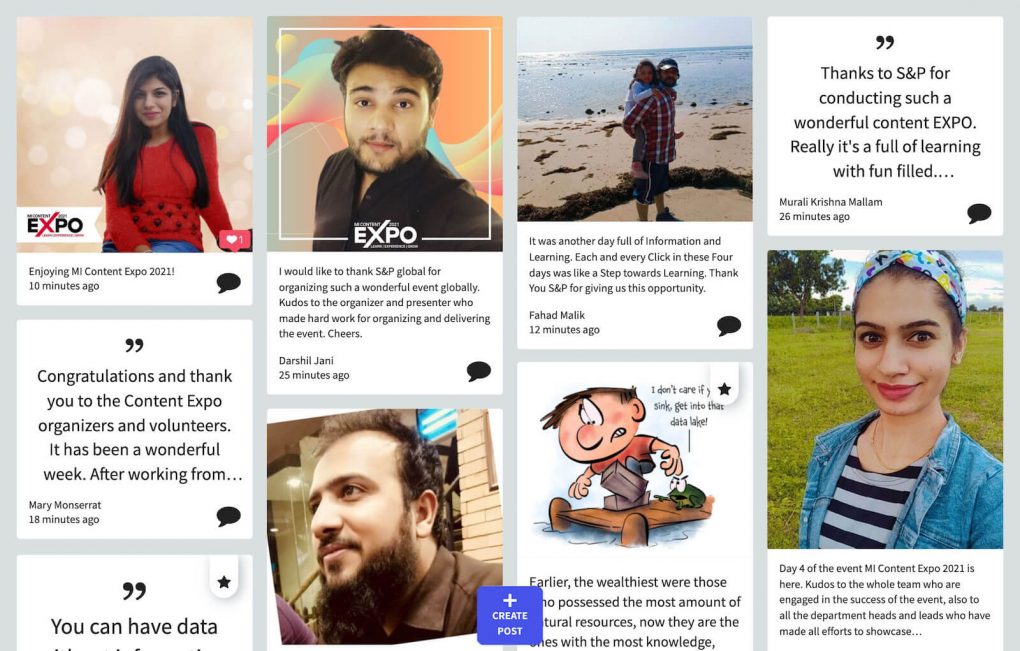
At first glance, a virtual internal conference might not scream “social.” But S&P flipped that script. Using a secure, app-embedded social wall and Direct Posts, they invited 5,000 employees to contribute selfies, questions, and even shoutouts—no social accounts required. They paired it with a photo booth for fun, but what stood out was the honesty. Posts ranged from jokes about working from home to pride in their teams’ work. In a remote-first world, this was culture-building at its best.
3. dvm360® Live Conference, U.S. regional series
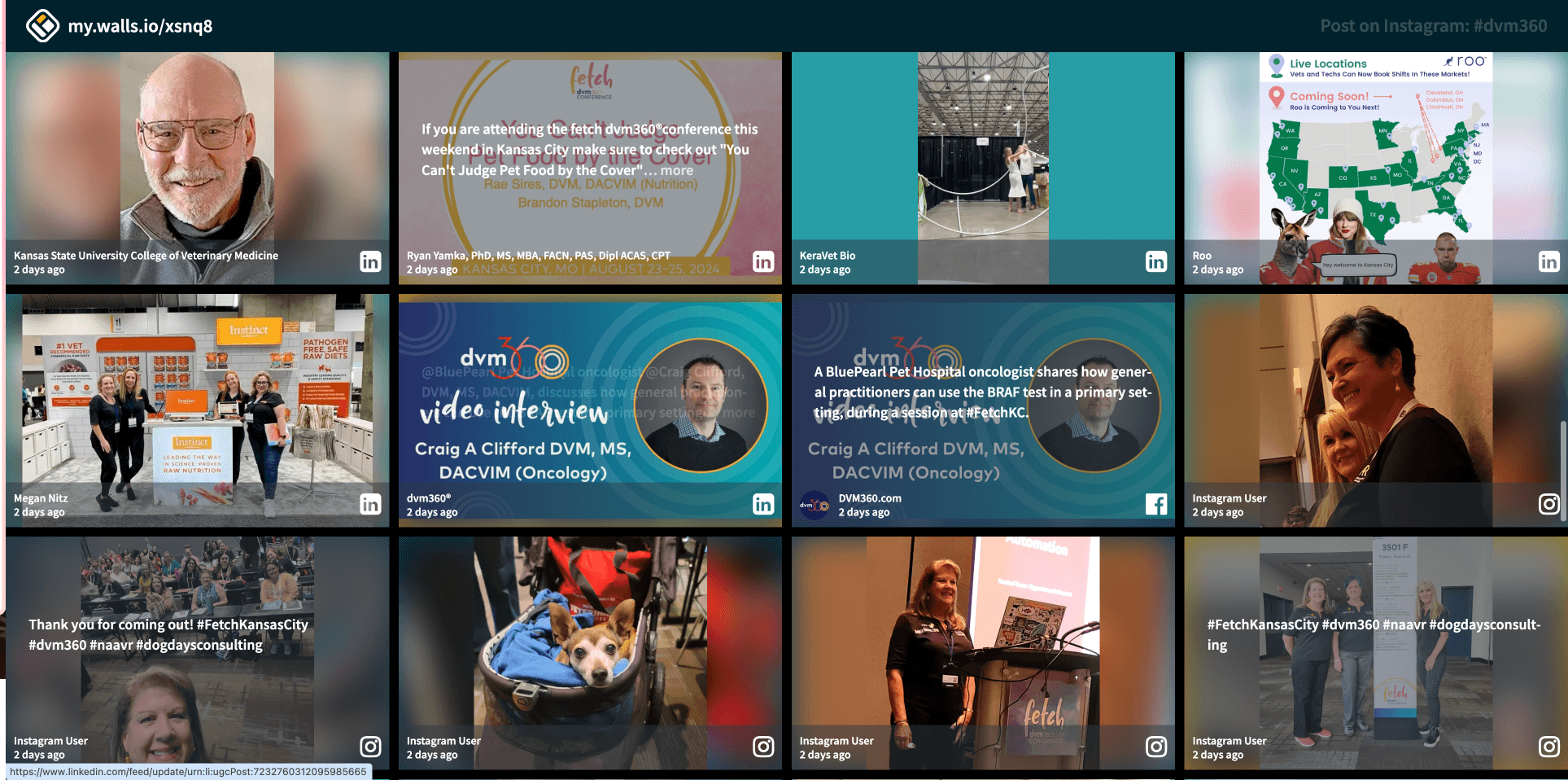
Veterinary pros aren’t always the loudest social media users—but this event found a way to get them posting. At their regional medical conference, dvm360® used a social wall embedded in the event app and shown on massive screens across the venue. Attendees could post on X, Instagram, or directly through the app. The incentive? Instant visibility. People snapped selfies with their badges, highlighted key takeaways, and celebrated moments with peers. What could’ve been a quiet event turned into a social feed buzzing with community pride.
When we think of social walls, we tend to picture flashy conferences and high‑energy public activations. But some of the most effective use cases are happening inside companies, behind closed doors, with no hashtags trending and no sponsors in sight.
We’re referring to internal events, such as leadership development retreats, annual kickoffs, and town halls. While important to organizations, these events often struggle with engagement. People show up because they have to, not because they’re eager to participate. However, there’s an easy solution to this. A well‑executed social wall can shift that dynamic by providing employees with a safe and visible way to express themselves.
Customer example: Insperity’s Global Fall Kickoff
At Insperity, the HR solutions provider addressed exactly this challenge during its annual global Fall Kickoff, with 4,500 employees across 18 locations. They deployed a private social wall using Direct Posts, collecting over 800 submissions—from photos and quotes to thank‑yous and candid team moments..
Why it worked at Insperity:

Emily Quick
Event Program Specialist at Insperity
We loved that Walls.io provided a hybrid solution for connecting both onsite and virtual audiences. Direct Posts created a safe and controlled environment for our internal audience while respecting their privacy.
They displayed the wall on onsite TVs and projectors, and embedded it into their intranet before, during, and after the event—all while running a contest to boost participation. The social wall wasn’t just decoration—it was the core of their internal communications strategy.
The key difference in internal settings? Privacy. Social walls for internal events offer direct upload options using a QR code, so people don’t need to post publicly on social media to get featured on the wall.
Let’s talk engagement tactics
So, how do you actually do this? How do you get people to post, share, and engage in a way that’s authentic and not forced?
Here’s what works:
1. Make it simple and worth it.
Don’t overcomplicate the process. Use one hashtag. Promote it early. Remind people at registration, during sessions, and even at the bar. And make the payoff clear: your post could end up on the big screen, or you could win something unexpected: a local gift, lunch with a speaker, or backstage access.
2. Moderate with empathy.
Global audiences mean varied perspectives. Don’t censor unless absolutely necessary. Instead, set clear boundaries and appoint moderators who understand the cultural context of your audience.
3. Give voice to the quiet corners.
Not everyone’s posting selfies. Make space for long-form thoughts, sketches, audio clips, or reactions in other languages. Let the social wall be a patchwork, not a pattern.
4. Use it before and after the event.
Build hype in the days leading up to the event by collecting stories or first impressions. After the event, turn the social wall into a highlight reel, or even print a zine that captures the best posts. This keeps the momentum alive.
Let’s be honest—not every social wall works. Some are ignored. Others turn into meme dumpsters. And a few go completely off the rails. So what causes a wall to flop? Here are the most common mistakes — and how to avoid them.
1. No one knows it exists
You’d be surprised how often this happens. The wall is live, but attendees were never told what to post, which hashtag to use, or what it’s even for. Fix this with proper promotion, not just on screens, but in sessions, in emails, on badges, and in the emcee’s script.
2. It feels like homework
If your idea of audience engagement is sharing a prompt like “Share thoughts using this 20-character hashtag and upload on our custom portal”, you’ve already lost your audience. The best way to get your audience to participate is by keeping engagement fun, frictionless, and immediate. Think selfie contests, emoji reactions, and one-word prompts.
3. It’s over-moderated
There’s a fine line between keeping it clean and scrubbing all personality out of it. A wall with only corporate-approved quotes and staged photos feels fake. Let it breathe. Let the inside jokes and oddball creativity come through, within respectful limits.
4. It ignores who’s in the room
This is especially important at international events. If your wall only features posts in English or if it has cultural references that alienate non-local audiences, you’re not building connections; you’re being exclusive.
A social wall feels like an extension of the room, but only when it’s done right. When done wrong, it feels like a screensaver.
Don’t forget the offline crowd
One final note. We talk a lot about social media, but not everyone’s online. Don’t leave out the attendees who aren’t posting—maybe because they’re camera-shy, off-grid, or just plain busy.
Offer analog ways to join the wall:
- Interactive kiosks where people can leave messages
- QR code check-ins that prompt a quick thought
- Instant photo booths that post directly to the stream
- Event staff who collect quotes or reactions on the floor
Inclusion isn’t just about platform diversity. It’s about giving every type of guest a way to show up.
Captivate attendees with a digital photo booth
It’s a wall, we get it, but don’t treat it like wallpaper. A social wall is not meant to just sit there with no one looking at it, it’s a waste of time. Your audience not only needs to know that it exists, but they also need to know where to find it. That means you need clear signage, a suitable location, and someone to inform people about its presence.
Also: moderate it. You don’t need to be heavy-handed, but don’t let random junk or off-topic posts flood the feed. A couple of bad posts can make the whole thing feel off.
Another one: don’t throw it in as an afterthought. If you’re launching the wall halfway through the event, you’ve already missed half the action. Build it into your run-of-show, and ensure your staff is aware of its purpose. If your people are not pointing it out or encouraging posts, no one else will either.
It doesn’t need to be perfect, but it does need to feel alive and part of the room.
The role of social walls is shifting. It’s no longer just about showing posts — it’s about designing moments. And as expectations evolve, so do the tools.
1. AI Curation
Instead of manually approving content, smart walls like Walls.io now use AI to surface the most relevant, high-quality, and emotionally resonant posts. Not just what’s trending, but what’s really moving people.
2. AR and VR Integration
At hybrid events, social walls are starting to appear within virtual spaces, projected onto digital stages or even as floating panels inside VR breakout rooms. It’s still early days, but the potential for immersive, audience-driven storytelling is massive.
3. Mobile-First Participation
With so many events experienced through phones, some organizers are designing wall interactions that feel like Instagram stories or interactive games. Tap to vote. Slide to react. Record to post.
4. Better Accessibility
Expect more focus on screen-reader compatibility and multilingual support. Forward-thinking social wall solutions like Walls.io already offer accessible social walls.
In short, the wall is growing up. And if you’re still treating it like a tech extra, you’re missing the real opportunity.
The bottom line: you need to make the audience the hero
The best events don’t just inform. They are involved. A well-designed social wall doesn’t shout “Look at us!” It says, “We see you.” It invites collaboration. It hands over the mic. And in doing so, it builds something bigger than a branded moment; it creates shared ownership.
So the next time you’re planning a global event—whether it’s a product launch in Tokyo, an art fair in Mexico City, or a summit in Paris, don’t just plan for content; plan for connection.
And maybe, just maybe, let the audience write the story with you.