

Organic event promotion is the best and most important type of marketing. Getting people to share their views and experiences at your event on social media, through the use of hashtags, is precious and something you can’t put a price tag on. Below are 11 proven strategies, based on real data about attendee behavior, that can help you increase event registrations without investing and eye and a leg.
1. Turn attendees and speakers into promoters with Walls.io Echo
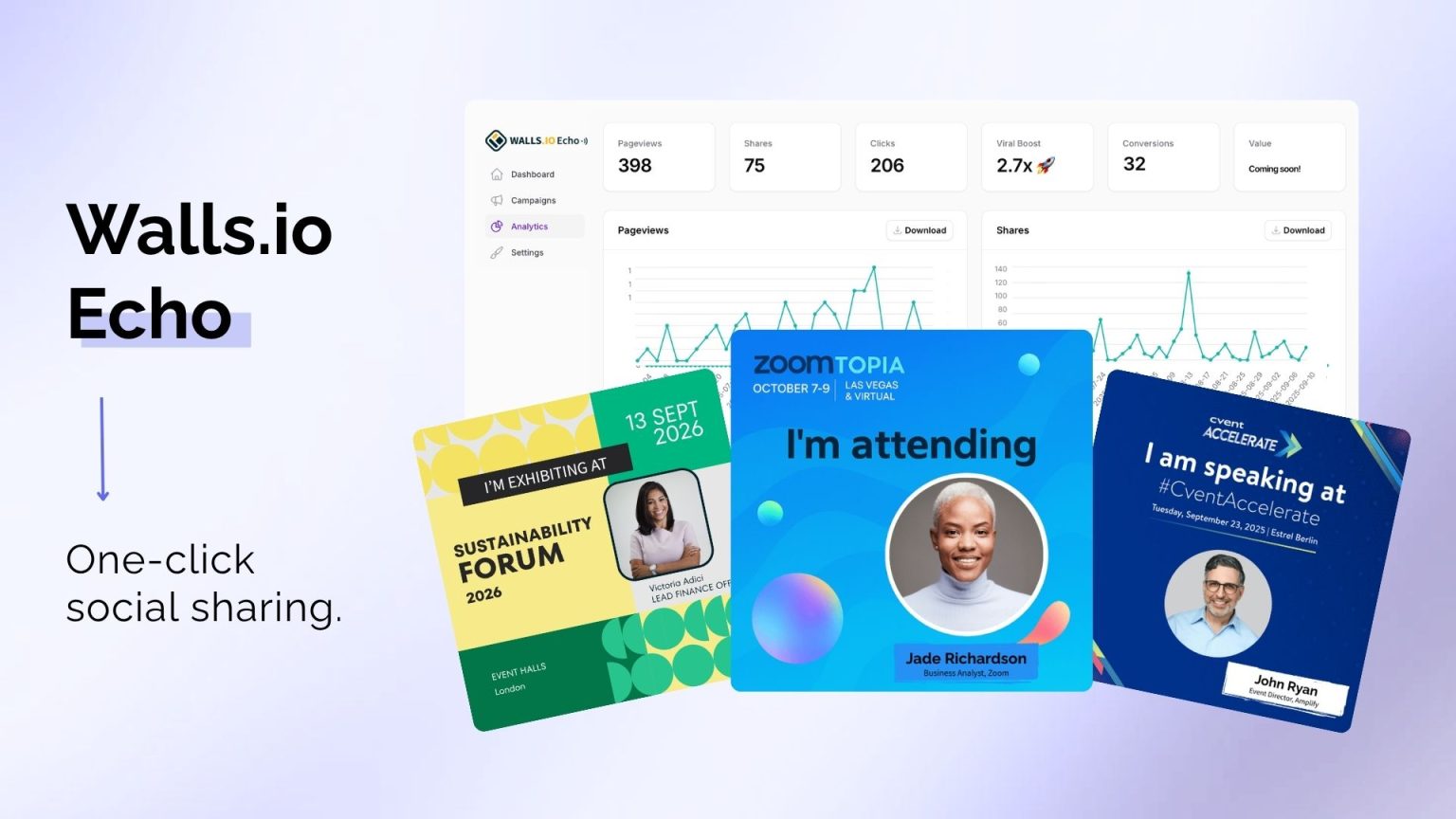
Walls.io Echo is the number one tool for organic event promotion. With Echo you can give attendees, speakers, sponsors, or employees a one-click way to become an ambassador of your event. All they have to do is choose a pre-determined sharing card, Echo fills in the caption, their profile photo and a background, and the post goes out to LinkedIn, Instagram, X, Facebook, WhatsApp, Telegram, SMS, or email in under 30 seconds.
Every card includes its own tracking link, so you’ll be able to see which posts, sharers, and platforms are actually driving clicks and sign-ups.
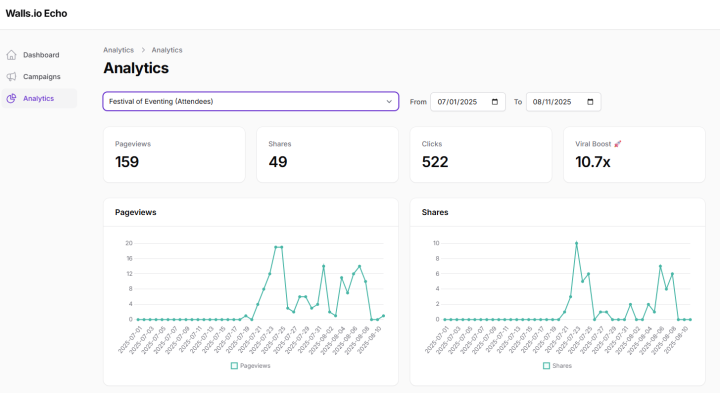
For the Festival of Eventing conference, creating pre-event excitement wasn’t left to chance. They knew attendee engagement had to start well before people walked through the venue doors. To make that happen, they turned to Walls.io Echo, which helped them get:
- 159 pageviews generated from Echo campaigns
- 49 shares
- 522 clicks on shared posts
- 10.7x viral boost, meaning speaker and attendee content reached more than 10 times beyond its initial audience
As Larna Jackson, Managing Director at Event Options, put it:“We wanted attendees to feel part of the event before they even arrived—and Walls.io helped us make that happen.”
👉 Ready to make your audience part of the story?
Start building interactive experiences with Walls.io today
2. Tell people what to post
The single biggest reason attendees don’t post about an event isn’t apathy. According to our research on UGC and event engagement, 30% cite a lack of clear instructions or prompts as the reason they didn’t share anything on socials or wall.
It might seem obvious for event organizers to assume that people will know what content to post, but the truth is not everyone has the wit to do in right away. And if they do, they mostly will post selfies (which are great! It’s just better to have some variety). So giving people ideas on what to post is a great guidance they will be appreciative of. Add instructions or examples in the confirmation email, on session signage, and on the speaker’s closing slides, give them the exact hashtag, a sample caption, and a specific moment to post it. If a prompt takes five seconds to read, it can help organic reach.
3. Ask before the event, not after
You don’t need to convince people to share. You need to ask them before you lose the window. The research a forementioned found that 67% of attendees are “very likely to create and share content” about an event they’re attending.
That’s most of your list of potential event participants ready to share your event with no cost. Include the request in the usual process: a reminder in the pre-event email, a QR code at check-in or while they’re getting their morning coffee. If you wait until the first day of the event, the chances of them posting are lower.
4. Focus your organic event promotion push on Instagram first
Not every platform makes the same amount of money for the same amount of effort. Among the people who went to the event, 45% said that Instagram is the best platform for event-related content. This is more than the next two platforms, Facebook and TikTok, combined.
If your team is busy, post the sharing prompts, hashtag creative ideas, and photo-friendly moments on Instagram first. This is where social media marketing for events is actually seen and shared by the people who were there. It’s also where a live wall pulling in tagged posts (Instagram content aggregated from hashtags and business profiles) can turn individual shares into one visible feed.
5. Give people a hashtag worth using
A hashtag only works if people know it exists and it’s worth typing. The same study found that 40% of attendees say that using hashtags with a brand’s name is the best way to get them to post, more than contests, photo booths, and live Q&A combined.
Choose one hashtag that is short and specific to the event, not the company. Put it everywhere before the event starts: email signatures, the registration page, speaker decks, sponsor kits. If you want a step-by-step process for choosing and launching one, our event hashtag strategy guide will show you how.
6. Run a low-cost contest instead of paying for reach
Contests are still better at getting people to make content than most paid tactics. In a survey, 32% of the people said contests or giveaways are the most effective way to get them to post.
A contest doesn’t need to have a big prize. A free ticket to next year’s event, a mention on the main screen, or a feature on your live wall is often enough. The way it works is more important than the budget. Give people a reason to post now, not later.
7. Set up a photo moment people want to be tagged in
21% of attendees say that photo booths or selfie stations are the most effective ways organizers get them to create content. It’s a simple setup with a big payoff, because a photo booth does the creative work for the person attending.
A photo booth with a brand name, like Walls.io’s Photo Booth feature, makes photos for your audience that are on your brand’s style. This way, people can post a finished, on-brand image in seconds instead of making one themselves. Put it up near the registration area or the main stage, where a lot of people are walking by and phone cameras are already in use. If you want to know more about layouts and placement, check out our guide to running a social photo booth at events.
8. Lead every ask with photos, not video or text
When you’re deciding what to ask people to post, photos are the best option. Most people who go to events (65%) say that photos are the most interesting type of content, compared to 18% for videos, 12% for reviews or testimonials, and 5% for text-based posts.
This means that you should request something different. If a speaker asks their audience to post a “quick video,” it’s asking for more effort than most people will give. If you ask for one photo of the stage, the badge, the swag, or the view, more people will complete the task. This method works best when the audience is reading it.
9. Put a live feed on your registration page
Static testimonials and stock photos don’t convince people the way real content does. Four out of ten people who go to events say that social media walls or live feeds are the best way to get people involved. This is better than live polls, interactive photo booths, and gamification.
The same logic applies even before someone has registered. A live wall pulling in real posts from last year’s event, Walls.io’s Social Media Aggregation feature, which collects content from social media and displays it anywhere, turns a static landing page into visible proof that people show up and enjoy themselves. To learn more about setting up and placing these displays, read how to maximize event engagement with an interactive social wall.
10. Get your speakers talking before they take the stage
Attendees don’t fully trust event marketing copy. They trust the people delivering the content. 17.6% of attendees say they trust speakers or partners most when forming an impression of an event, right behind their fellow attendees.
Email outreach to speakers is one of the most underused organic event marketing tactics. Send speakers a ready-made asset (a quote card, a one-line abstract, a sharing link) two to three weeks before the event, and most will post it to their own audience without being asked again. Our guide on how to turn speakers into event promoters goes into more detail on the outreach sequence.
11. Let past attendees do the convincing for you
People trust what other people say about a brand’s event more than they trust the brand itself. 59.8% of attendees say they trust fellow attendees most when forming impressions of an event. This is the highest trust score of any source measured.
This is the best argument for email marketing for events. It focuses on real people instead of well-written text. Use quotes, photos, and posts from past attendees in your next registration campaign. A short quote from someone who was there will work better than a long paragraph written by you.
Collect Event UGC without moving a finger
FAQ about organic event promotion
What is organic event promotion? Organic event promotion strategies drive awareness and registrations through unpaid channels, social sharing, email outreach, word of mouth, and user-generated content, instead of paid ads. They rely on people who are already connected to the event (like attendees, speakers, sponsors, and employees) to share it with their own audience.
How can I get more people to sign up for my events without having to pay for ads? Start with the people who are already close to the event. Give the people at the event a clear way to share (like a special hashtag, a caption you can write in advance, or a one-click sharing card). And ask for this information before the registration window closes, not after the event ends.
What free event promotion tools should I use? A branded hashtag costs nothing to launch, and email is likely a tool you already own. Walls.io Echo is a free tool that turns any registration list into a shareable campaign that you can track. It also has a live social wall on your registration page that you can try for free before committing to a paid plan.
Is email marketing still effective for events? Yes. Email is still one of the best ways to sell tickets for events because it gets the attention of people who are already interested in the event. Pairing it with attendee quotes, past-event photos, or a direct sharing link performs better than a generic reminder.
When should I start promoting my event? It’s best to contact potential speakers and sponsors two to three weeks before the event, which gives them enough time to post without forgetting. We should send out attendee-sharing prompts as soon as someone registers, while they are most likely to attend.
Ready to put these organic event promotion strategies into practice?
You don’t need to spend more money on ads to fill more seats. The event promotion strategies above require only a little planning: ask early, give people a reason to post, and let your own audience do the convincing. Start with Walls.io Echo and give your next registration list a reason to talk.