
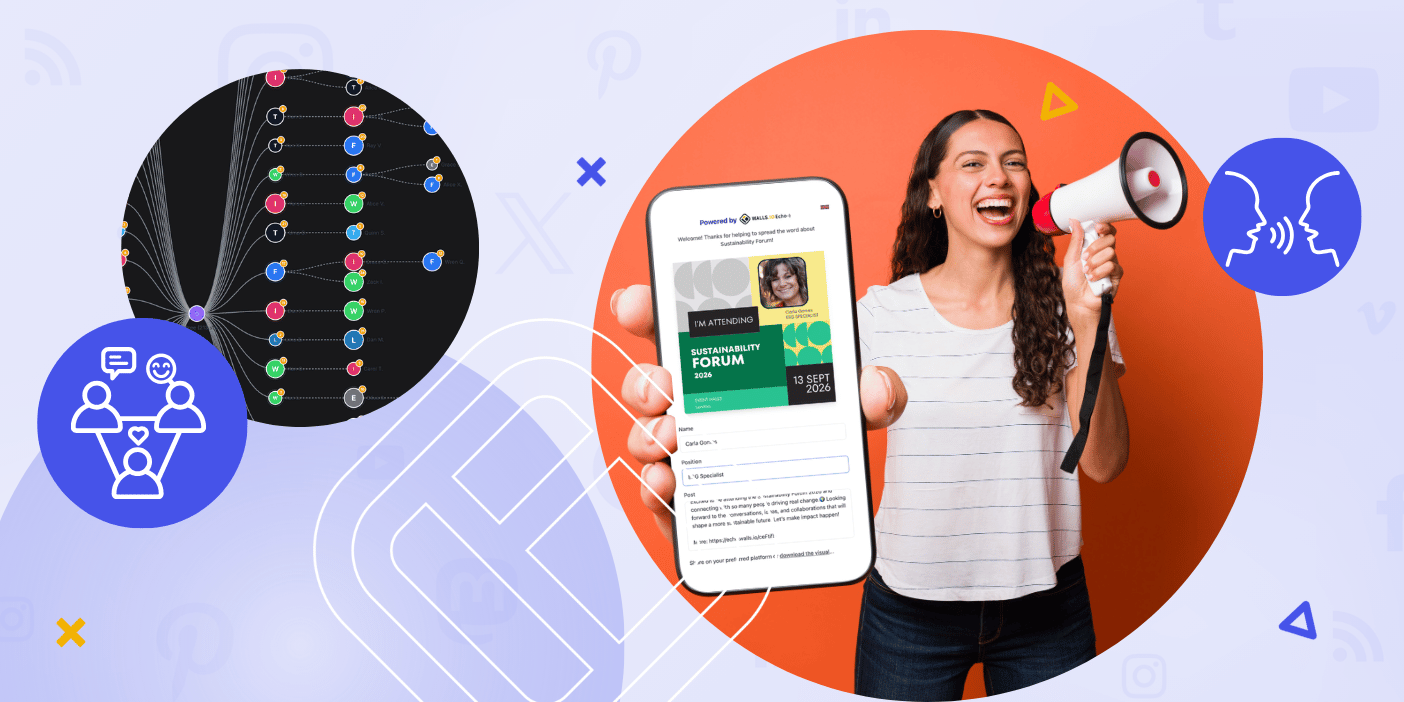

Three weeks before your event, the speakers you booked haven’t posted about it once. The hashtag is quiet. Your ad spend is climbing and your reach is shrinking anyway. Meanwhile, a few thousand people already have a reason to talk about your event — a ticket, a session, a sponsorship, a booth — and nobody’s given them an easy way to say it.
TL;DR: Word-of-mouth marketing for events is the process of encouraging attendees, partners, sponsors, and other audience members to voluntarily recommend your event to others. Because people tend to trust recommendations from friends and colleagues more than advertisements, it can be one of the most effective and cost-efficient ways to increase attendance simply by means of spreading the word. The fastest way to run it well is a social sharing template, and Walls.io Echo is built to generate and track those templates for you.
Check out our event promotion tool, Walls.io Echo.
What is word-of-mouth marketing for events?
Word-of-mouth event marketing is a form of event promotion that enables the people already connected to your event to speak about it for you. That’s speakers announcing their session, sponsors posting to their own audience, exhibitors telling their customers where to find them, and attendees telling their network they’ll be there.
This is different from a referral program, which pays someone for an introduction, and different from organic social buzz, which you can’t attribute to anyone or measure with any precision. A strong word-of-mouth marketing tool asks a real person to say one true thing — “I’ll be speaking at this” or “I’m going to this” — and then tracks exactly what that sentence was worth in reach and registrations.
Why should you care about word-of-mouth marketing for your event?
Because the channels you’ve relied on are getting more expensive and less effective at the same time. Organic reach on a brand’s own social accounts keeps shrinking, and paid reach still works, but CPMs climb every cycle, so the same registration costs more than it did for the identical event last year.
Meanwhile, a recommendation from someone you know still outperforms almost anything a brand can buy. Edelman Digital Trust Barometer’s research from 2025 found that 88% of people trust recommendations from people they know more than any form of corporate advertising. Peers are one of the highest-trust channels, and one most event teams struggle to activate on purpose. A named colleague posting “I’m speaking at this” reads as credible in a way no ad ever will, especially now that feeds are being filled with AI generated content and a real person’s post stands out precisely because it’s real.
In essence, the channel getting more expensive is the one you’re depending on, and the channel that’s low cost is the one nobody’s using. Closing that gap doesn’t replace your paid and organic strategy. It gives you a third channel that costs a fraction as much and converts better because the person clicking the link already trusts whoever sent it.
What methods do event marketers typically use?
Most word-of-mouth strategies for events fall into a handful of approaches:
- Speaker, partner, and sponsor kits: A zip file of pre-approved graphics, a caption, and a personal link that is sent when a speaker is confirmed, a sponsorship is signed, or a partner agrees to participate.
- Attendee referral prompts: Sent at registration and in confirmation emails, giving new registrants an incentive and a link to invite a colleague.
- Hashtag campaigns: A shared hashtag that everyone posting about the event can rally around, which can also be collected in a social wall.
- Employee advocacy: Turning your own teams into promoters, since their networks often include exactly the buyers your ads can’t reach.
- In-app and confirmation share prompts: A one-tap share option inside the event app or registration confirmation, timed for the moment someone is already thinking about the event.
In reality, what does this often look like? If we take the media kit example, we typically get something like this:
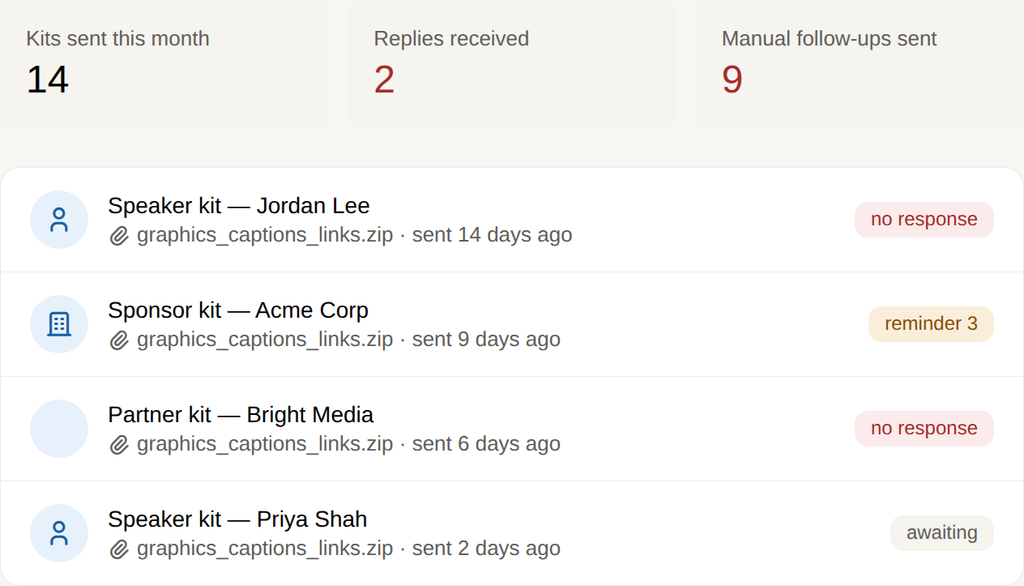
While each of these methods works, the time that it requires to execute the task quietly kills them. You are essentially assigning your audience a homework assignment they didn’t sign up for. That’s why the highest-performing version of word-of-mouth marketing isn’t a request – it’s a ready-made asset with almost nothing left for the person to do.
A social sharing template solves the exact problem that stalls every other method: it removes the work. Instead of asking a speaker, sponsor, or attendee to build a post from scratch, you hand them one that’s already built. Their name and photo are dropped in, the caption pre-filled, your branding intact, and a trackable link baked in. Posting takes under a minute instead of feeling like an assignment.

Here’s how a word-of-mouth event marketing tool compares against other methods:
| Channel | Who’s talking | What is costs you | What you can prove |
| Paid social & search | Your brand | Rising CPMs | Everything, as long as you keep paying for it |
| Organic social | Your brand | Team time | Reach, if the algorithm cooperates |
| Referral programs | Customers, for a reward | Discounts and incentives | Codes redeemed |
| Word-of-mouth marketing | Speakers, sponsors, partners, attendees, your team | A template and a link | Everything, with a one-time investment (using Walls.io Echo) |
An event promotion tool that allows you to share word-of-mouth marketing templates should also solve the measurement problem. This is precisely what Walls.io Echo is built for. Echo generates branded, ready-to-post sharing cards for speakers, sponsors, exhibitors, and attendees in seconds, with the caption and tracking link already attached. Every share gets its own link, so you can see exactly who posted, how far it traveled, and how many registrations it produced, all in one dashboard instead of a spreadsheet stitched together after the fact.
Not only does Echo equip the people already connected to your event with something ready to share, and a reason to share it – it also saves them time. Your audience can easily personalize their templates with different profile pics, captions, and role titles, or they can choose the default options you set for them so that a post can be made within 30 seconds. On top of that, the event organizers get ROI that can be actively measured.
Word-of-mouth marketing turns the people already invested in your event into a powerful extension of your marketing team without the rising costs of paid reach. The key is making it effortless for speakers, sponsors, partners, and attendees to share something authentic, on-brand, and trackable.
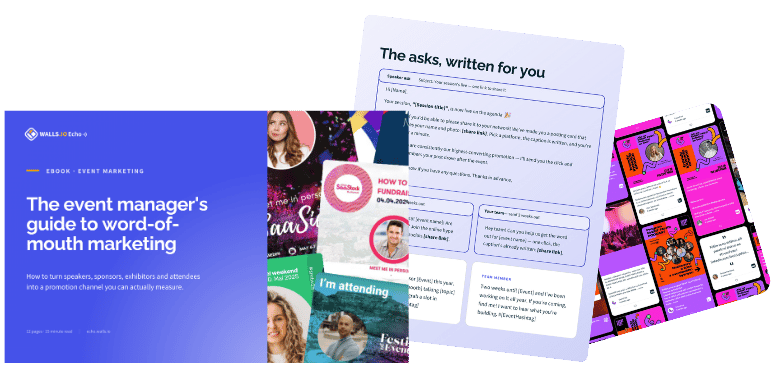
If you’re considering a word-of-mouth strategy that drives registrations and proves its ROI, download the free Event Manager’s Guide to Word-of-Mouth Marketing.
It’s packed with practical strategies, copy/paste templates, a customer case study, and tips to help you turn your event audience into your best promoters.
FAQ
Is word-of-mouth marketing the same as influencer marketing?
No. Influencer marketing pays someone with a large following to promote your event. Word-of-mouth marketing activates people who already have a real connection to your event (speakers, sponsors, attendees) regardless of how many followers they have.
How early should I start a word-of-mouth campaign?
Speakers respond best when you reach them as soon as their session is confirmed, often 12 weeks out. Sponsors and exhibitors are easiest to activate at contract signing. Attendees convert best right at registration and again in the final 10 days before the event, when urgency kicks in.
Can I measure word-of-mouth marketing the way I measure ads?
Yes, if you use tracked links per person or per template. Without individual tracking, you’re left guessing at correlation between a hashtag trending and registrations rising. A dedicated tool like Echo attributes every click and registration back to the specific share that produced it.